


Can you buy THC-A at 18? It depends on your state. Most require you to be 21+, but a few allow 18+ under strict medical conditions. Online retailers almost always stick to 21+ due to payment and shipping rules.
Key Takeaways:
- Federal Rules: THC-A is legal under the 2018 Farm Bill if it contains <0.3% Delta-9 THC by dry weight.
- State Laws: Age limits vary. Most states set 21+ for recreational use; a few allow 18+ for medical patients.
- Upcoming Changes: A federal ban on intoxicating hemp products is set for November 2026.
- Compliance Tip: Always check local laws and stick to lab-tested products to avoid legal issues.
Quick Overview:
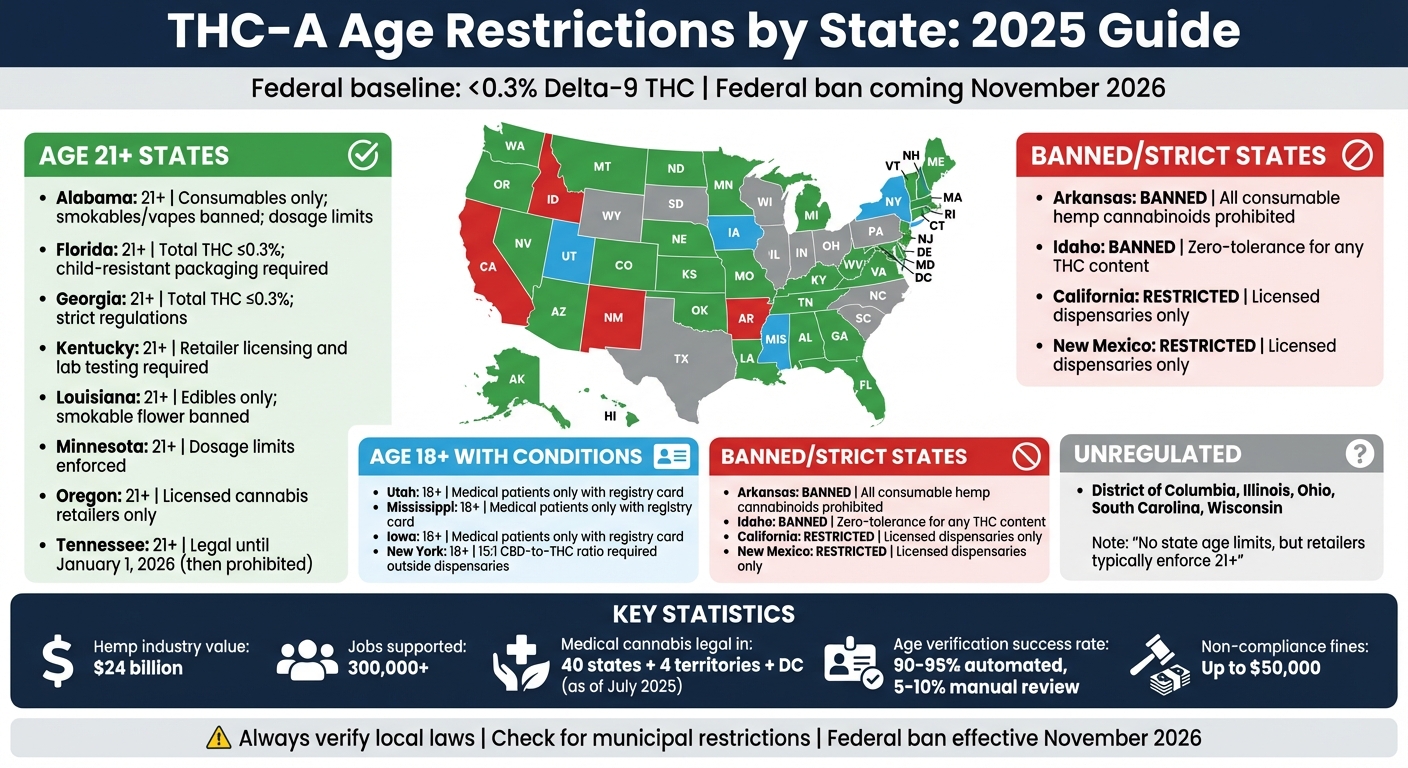
- 21+ States: Alabama, Florida, Georgia, Kentucky, Louisiana, Minnesota, Oregon, Tennessee.
- 18+ (Medical Only): Utah, Mississippi, Iowa, New York (with conditions).
- Banned/Strict States: Arkansas, Idaho, California, New Mexico.
Navigating THC-A laws is tricky since they vary by location and are evolving fast. Stay informed, shop responsibly, and always verify your age when buying.
21 + only. Hemp-derived; contains < 0.3 % Δ-9 THC (dry weight). Effects may be delayed up to two hours. Check local laws.
THC-A Age Requirements by State 2025: Complete Legal Guide
Texas governor sets minimum age to buy THC products to 21
Federal THC-A Regulations: The Baseline
The 2018 Farm Bill defines hemp as any part of the Cannabis sativa L. plant containing no more than 0.3% delta-9 THC by dry weight. Interestingly, this federal definition focuses solely on delta-9 THC, leaving THC-A largely unregulated at the federal level. This loophole allows for high-THC-A products to remain compliant - so long as they are not decarboxylated, which would convert THC-A into delta-9 THC.
The Farm Bill also does not establish a nationwide minimum age for purchasing hemp-derived products. This lack of federal guidance leaves states to decide their own age restrictions, with many aligning with existing recreational cannabis or alcohol laws, often setting the minimum age at 21.
However, the U.S. Drug Enforcement Administration (DEA) has proposed a stricter "total THC" calculation. This method combines delta-9 THC and THC-A levels, and if the combined total exceeds 0.3%, the product is treated as a controlled substance. In response to this proposal, several states have adopted "Total THC" standards, effectively closing what has been dubbed the THC-A loophole.
Federal regulations do allow states to impose stricter rules than those outlined in the Farm Bill. While the bill protects the interstate transportation of hemp, it also includes a savings clause that permits states to regulate production and sales within their borders more rigorously. As a result, products that meet federal compliance standards may still face tighter restrictions in certain states.
The hemp industry, valued at an estimated $24 billion, supports over 300,000 jobs across the United States. However, federal lawmakers have begun reevaluating the scope of hemp regulations. In late 2025, steps were taken to narrow the definition of hemp, with a federal ban on intoxicating hemp products included in a November 2025 funding bill. This ban is set to take effect in November 2026. The next section will explore how individual states build on this federal framework to establish their own age requirements.
State-by-State THC-A Age Requirements
While federal guidelines establish a baseline, most states take it a step further, enforcing a 21+ age rule for THC-A products. These state laws often align with those governing recreational cannabis and alcohol, but the specifics can vary dramatically from one state to another. Some states impose strict limits, others carve out exceptions for younger individuals under medical conditions, and a few ban THC-A products altogether. Additionally, states that use "Total THC" calculations may classify high-percentage THC-A products as regulated marijuana when heated. Below, we break down how these rules play out across the country.
States Requiring Age 21+
The majority of states that allow THC-A sales require buyers to be at least 21 years old. This includes states like Alabama, Florida, Georgia, Kentucky, Louisiana, Minnesota, Oregon, and Tennessee. Each state also adds its own layer of restrictions to the mix.
- Alabama: Adults can purchase consumable products like gummies or drinks, but smokable hemp products and vapes are banned. Dosage limits also apply under the state's recently established licensing system.
- Florida: Products must maintain a Total THC content of 0.3% or less and use child-resistant packaging.
- Tennessee: Sales are allowed for those 21 and older, but a prohibition on hemp-derived THC products will take effect on January 1, 2026.
- Louisiana: THC-A edibles are permitted for adults, but smokable flower is not.
- Minnesota: Dosage limits are strictly enforced.
- Oregon: THC-A products can only be sold through licensed cannabis retailers.
Here’s a quick overview of these states and their key restrictions:
| State | Age Requirement | Key Restrictions |
|---|---|---|
| Alabama | 21+ | Consumable products only; smokables/vapes banned; dosage limits apply |
| Florida | 21+ | Total THC ≤0.3%; requires child-resistant packaging |
| Georgia | 21+ | Total THC ≤0.3% with strict regulations |
| Kentucky | 21+ | Requires retailer licensing and lab testing |
| Louisiana | 21+ | Edibles only; smokable flower banned |
| Minnesota | 21+ | Dosage limits apply |
| Oregon | 21+ | Sales restricted to licensed cannabis retailers |
| Tennessee | 21+ | Legal until January 1, 2026; then prohibited |
States Allowing Age 18+ with Conditions
A few states make exceptions for individuals aged 18 to 20, but only under specific medical conditions. Utah, Mississippi, and Iowa allow THC-A purchases for registered medical marijuana patients who meet qualifying criteria. Meanwhile, New York has crafted its own unique rules: hemp products sold outside licensed dispensaries must maintain a 15:1 CBD-to-THC ratio, effectively limiting potency while lowering the age threshold under controlled conditions.
Prohibited or Unregulated States
Some states have taken a hardline stance, outright banning THC-A products. For example:
- Arkansas: Prohibits all consumable hemp-derived cannabinoids, including THC-A.
- Idaho: Maintains a zero-tolerance policy for any THC content, making THC-A illegal regardless of its hemp origin.
- California and New Mexico: Recent emergency regulations ban intoxicating hemp products from general retail, restricting sales to licensed dispensaries.
In other areas, THC-A remains unregulated at the state level but still falls under the federal provisions of the 2018 Farm Bill. States like the District of Columbia, Illinois, Ohio, South Carolina, and Wisconsin don’t specify age restrictions, though retailers often enforce strict age verification policies. Additionally, municipal codes in some cities or counties may impose their own rules, so local laws should always be checked.
Know Before You Buy
Before purchasing THC-A products, it’s crucial to confirm your state’s current regulations. Crossing state lines with these products can also be risky - states like Idaho and Nebraska may confiscate items that don’t meet their definitions of hemp. Staying informed about local laws is key to avoiding legal complications, as we’ll explore further in the next sections.
21 + only. Hemp-derived; contains < 0.3 % Δ-9 THC (dry weight). Effects may be delayed up to two hours. Check local laws.
sbb-itb-3a0b05a
Medical Access to THC-A Products
When it comes to THC-A access, medical programs provide a critical pathway for patients who don’t meet the age requirements for recreational use. While recreational THC-A sales are limited to individuals 21 and older, medical programs allow younger patients - including minors - with qualifying conditions to access these products. By July 2025, cannabis for medical use will be legalized in 40 states, four U.S. territories, and the District of Columbia. These programs prioritize medical necessity over age, enabling access for patients under 21 when a physician certifies a qualifying condition.
Take Georgia as an example. The state’s Low-THC Oil Registry program includes THC-A under its legal definition of THC, offering a clear distinction from recreational rules. While retail THC-A products are restricted to those 21 and older, medical programs in Georgia allow younger patients to legally possess up to 20 ounces of low-THC oil, provided a parent or guardian holds the required registry card.
Recreational vs. Medical Age Limits
The difference between recreational and medical access becomes evident when comparing their age policies. Recreational THC-A purchases require a government-issued ID proving the buyer is at least 21, but medical programs rely on physician recommendations rather than rigid age limits. This means individuals as young as 18 with conditions like PTSD - or even minors with severe seizure disorders - can obtain THC-A products through medical channels, a level of access unavailable under recreational rules.
Here’s a quick breakdown of the distinctions between recreational and medical access:
| Access Type | Age Requirement | Required Documentation | Product Source |
|---|---|---|---|
| Recreational/Retail (Hemp) | 21+ | Government-issued ID | Smoke shops, gas stations, online retailers |
| Medical Program (Adult) | 18+ | Physician recommendation & State Registry Card | Licensed medical dispensaries or specialized pharmacies |
| Medical Program (Minor) | Under 18 | Parental consent, physician recommendation & Registry Card | Licensed medical dispensaries or specialized pharmacies |
States often tailor their medical programs to account for both age and condition severity. For instance, in Georgia, adults 18 and older can qualify for the registry with conditions like PTSD or Autism Spectrum Disorder, while minors must meet stricter criteria, such as a diagnosis of “severe autism”. Other states follow similar tiered systems, creating nuanced access rules based on patient age and medical need.
Parental Consent and Documentation Requirements
For minors, accessing THC-A products comes with additional layers of oversight and documentation. Parents or guardians act as registered caregivers, submitting a physician’s certification that outlines the qualifying condition, recommended dosage, and treatment duration. The Georgia Access to Medical Cannabis Commission explains:
"Georgia is a 'medical cannabis' low-THC oil patient registry state, which means there is a lawful pathway for patients registered with the Georgia Department of Public Health... to purchase and possess 20 ounces or less of low-THC oil and products".
Approval often involves consulting specialists such as pediatricians, neurologists, or pain management experts. Conditions for minors typically include severe illnesses like end-stage cancer, Crohn’s disease, multiple sclerosis, and severe seizure disorders. Some states, like Delaware, restrict minors to oil-based products, banning smokable flower or edibles that might appeal to children. Connecticut also enforces a more limited list of qualifying conditions for minors compared to adults.
Once a minor is approved, caregivers must maintain proper documentation at all times. This includes keeping products in their original, labeled containers with clearly marked THC/THC-A percentages, carrying the physical Low-THC Oil Registry Card, and ensuring all packaging is child-resistant. These measures not only protect families from legal risks but also ensure minors receive consistent, medically supervised care throughout their treatment.
How to Stay Compliant with THC-A Regulations
Navigating THC-A regulations isn’t just about following the law - it’s about ensuring safety and quality in the products you choose. By understanding key processes like age verification and prioritizing lab-tested products, you can stay on the right side of the law while enjoying peace of mind.
ID Verification and Retailer Policies
Legitimate THC-A retailers take age verification seriously, using multiple layers of checks to ensure compliance. It usually starts with an age gate where you enter your birthdate. From there, systems like AgeChecker match your name, address, and birthdate against public records. This automated process verifies about 90% to 95% of customers instantly. For the remaining 5% to 10%, a government-issued ID must be uploaded for manual review, typically completed within 24 hours.
Age verification isn’t just a formality. Payment processors, insurance companies, and shipping carriers treat hemp products similarly to alcohol, requiring buyers to be at least 21 years old. Retailers who fail to comply risk hefty fines - up to $50,000 during compliance audits. For online purchases, shipping carriers often require an adult signature (21+) upon delivery to confirm the recipient meets the age requirement.
Beyond verifying age, choosing products that meet strict testing standards is equally critical.
Choosing Lab-Tested, Legal Products
Lab testing is the backbone of compliance and safety. When you buy from trusted retailers like HALF BAK'D, you’re not just getting high-quality products - you’re getting peace of mind. Every product should come with a Certificate of Analysis (COA) from a third-party lab, which confirms cannabinoid potency and verifies that the product contains less than 0.3% Delta-9 THC by dry weight, as required under the 2018 Farm Bill.
HALF BAK'D stands out with a 4.9/5 rating based on over 660 reviews and boasts more than 10,500 5-star reviews from satisfied customers. Their products undergo thorough third-party lab testing to ensure accuracy in potency, purity, and safety. This level of transparency means you can trust that what’s on the label matches what’s in the product.
When shopping for THC-A products, keep an eye out for these compliance indicators:
| Factor | Reputable Retailer (e.g., HALF BAK'D) | Unregulated/Risky Seller |
|---|---|---|
| Lab Testing | COAs from third-party labs, easy to access | No lab results or outdated data |
| Age Verification | Robust systems like AgeChecker | Simple or nonexistent checks |
| Legal Compliance | Meets 2018 Farm Bill standards (<0.3% D9) | Potency may exceed legal limits |
| Shipping Policies | Discreet packaging with clear return info | Vague or no shipping details |
| Customer Reviews | Thousands of verified 5-star reviews | Few or questionable feedback |
HALF BAK'D’s signature products, like Sumo Gummies and Sumo Sour’d Gummies, are prime examples of their dedication to quality. Customers rave about the bold flavors - think Wild Watermelon and Monster Mango - and appreciate the absence of that “grassy aftertaste” often found in lower-quality products. Whether you’re into gummies, vapes, or concentrates, sticking with reputable brands that prioritize lab testing and strict age verification keeps you compliant while delivering a safe and enjoyable experience.
21 + only. Hemp-derived; contains < 0.3 % Δ-9 THC (dry weight). Effects may be delayed up to two hours. Check local laws.
Conclusion
Navigating THC-A age restrictions isn't just about following the rules - it's about ensuring safety and staying on the right side of the law. As we've discussed, most states require buyers to be 21 or older, regardless of specific local laws. This standard is driven by industry-wide practices, with payment processors, shipping carriers, and insurance providers all leaning toward a universal 21+ policy. Wherever you live, you should expect to verify your age when purchasing THC-A products. With regulations constantly evolving, keeping up with state and federal updates has never been more crucial.
The legal framework around hemp-derived products is changing rapidly. A federal provision passed in November 2025 plans to outlaw many intoxicating hemp-derived products by November 2026, effectively closing the "Farm Bill loophole" that allowed THC-A products to thrive. States like Arkansas have already taken steps to ban consumable hemp-derived cannabinoids entirely, while California limits sales to its regulated marijuana market. With these shifts happening at such a fast pace, staying informed about your state's laws is essential. These developments highlight the need for vigilance when purchasing THC-A products to ensure compliance.
When buying THC-A products, it's smart to choose retailers who prioritize lab testing and strict compliance. For example, HALF BAK'D stands out with products rated 4.9/5 from over 660 reviews and boasting more than 10,500 five-star ratings. Their offerings meet the legal threshold of 0.3% Delta-9 THC and undergo thorough third-party lab testing. This commitment to quality and compliance ensures that you're staying within legal boundaries as regulations continue to shift.
21 + only. Hemp-derived; contains < 0.3 % Δ-9 THC (dry weight). Effects may be delayed up to two hours. Check local laws.
FAQs
What does the upcoming federal ban on intoxicating hemp products mean for the industry?
The federal ban, scheduled to kick in by November 2026, is set to shake up the hemp industry. It will outlaw most intoxicating hemp-derived products, including THC-infused gummies, vapes, and concentrates. Anything that doesn’t fit the new legal definition will be reclassified as a Schedule I substance under the Controlled Substances Act. This means potential criminal penalties and a scramble for retailers to clear these products from their shelves.
Manufacturers will face a challenging year-long transition period to adapt. They’ll need to reformulate products, redesign packaging, and meet stricter compliance standards. Analysts are already predicting a financial hit for the industry, with revenue losses tied to restricted products and rising costs for testing and legal updates. For premium hemp brands like HALF BAK'D, staying ahead of the curve by focusing on compliant, non-intoxicating products will be key. Early action isn’t just about survival - it’s about keeping customer trust intact while navigating this regulatory shift.
Can individuals under 21 legally use THC-A for medical purposes?
In several states, individuals under 21 can legally obtain THC-A for medical use, provided they have a valid recommendation from a licensed physician. This process usually involves receiving a diagnosis for a qualifying medical condition and registering with the state’s medical cannabis program. For minors, a caregiver - often a parent or guardian - must oversee and assist with the application and purchase process.
Once approved, minors can access THC-A products through licensed medical dispensaries, as long as the products meet federal guidelines, including the requirement that they contain no more than 0.3% Δ-9-THC. Since regulations differ across states, it’s crucial to review the specific laws in your area. Generally, medical cannabis laws shield certified patients, including those under 21, from legal repercussions.
Why do most online stores require you to be 21 or older to buy THC-A products?
Most online retailers require customers to be 21 or older to purchase THC-A products. This age restriction isn’t just about following state laws - it’s tied to the rules set by payment processors and financial institutions. These companies often mandate that buyers meet the 21+ age threshold, regardless of the legal age in individual states.
By sticking to this standard, businesses align with federal compliance requirements and maintain a uniform system for verifying age across the country.